Arts Education at the Frontier of Human-Machine Collaboration
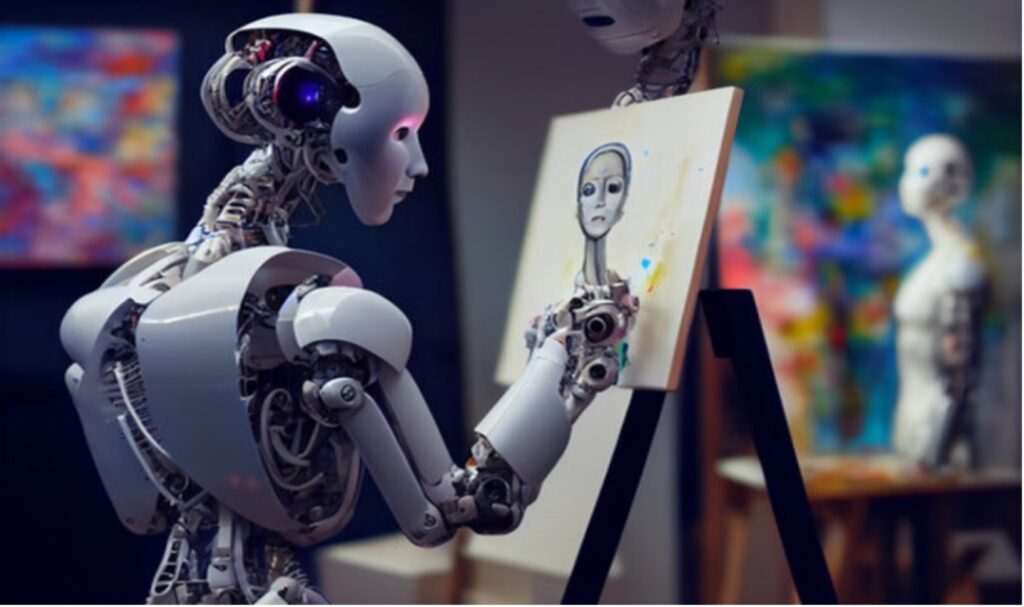
As robots become more integrated into our daily lives—from healthcare to hospitality, from classrooms to concert halls—the question is no longer if we will coexist, but how. For arts education leaders, this moment presents a profound opportunity to shape the emotional intelligence of our future robotic collaborators through the arts and educational technologies.
Empathy, long considered a uniquely human trait, is now a frontier in robotics and artificial intelligence (AI). While machines can process data at quantum speeds, they lack the intuitive understanding of human emotion that underpins meaningful communication, collaboration and creativity. This is where arts education becomes essential—not just for students, but for the machines they will one day teach, train and perform alongside.
Why Empathy Matters in Human–Robot Collaboration
In dance, theater and music, timing, gesture and emotional nuance are everything. As robots begin to enter these spaces as both tools and co-creators, empathy becomes a functional requirement. A robot that can interpret a dancer’s movement or respond to a musician’s tempo must be trained not only in both mechanics and meaning.
Educational technologies such as motion capture, spatial computing and immersive analytics are already being used to teach robots how to “read” human behavior. But without the interpretive lens of the arts, these systems risk becoming technically proficient yet emotionally tone-deaf. Arts educators are uniquely positioned to bridge this gap.
The Role of Arts Education in Teaching Machines
Arts education offers a framework for teaching context, symbolism and emotional resonance—skills that are difficult to quantify but are essential for empathetic interaction. For example:
- Theater programs can help train robots to recognize facial expressions and vocal inflections.
- Dance curricula can inform robotic motion planning that is expressive rather than mechanical.
- Music education can guide AI in understanding rhythm, harmony and emotional tone. By integrating these insights into STEM and robotics curricula, we can create learning environments where students not only build machines but teach them to understand us.
In teaching the arts in all their expressive depth, educators train AI to recognize emotion as meaning, turning empathy into a programmable outcome.
Quantum Computing and the Acceleration of Empathetic AI
The rise of quantum computing will exponentially increase the speed and complexity of machine learning. This means robots will soon be able to process vast emotional and sensory datasets in real time. But speed alone does not equal sensitivity. Without arts-informed frameworks, these systems may misinterpret or overlook the subtleties that make human interaction meaningful.
Arts education leaders can play a critical role in shaping the ethical and emotional dimensions of this technological evolution. By collaborating with technologists, they can ensure that empathy is a design principle rather than an afterthought.
A Call to Action for Arts Education Leaders
As we prepare students for a future where humans and robots co-create in studios, stages and classrooms, arts education must evolve. This means:
- Partnering with technologists to develop interdisciplinary curricula
- Advocating for arts-integrated robotics programs in schools and community centers
- Exploring new performance formats that include robotic collaborators
By doing so, we not only future-proof arts education—we redefine what it means to be human in an age of intelligent machines.
Conclusion
Empathy is not just a human virtue; it is a design challenge, a pedagogical imperative and a creative opportunity. Arts education has the tools to meet this moment. Let’s use them to teach our future robotic partners not just how to move, but how to feel.