From Mystery to Mastery: Why Standards-Based Grading is a Game-Changer for Arts Education
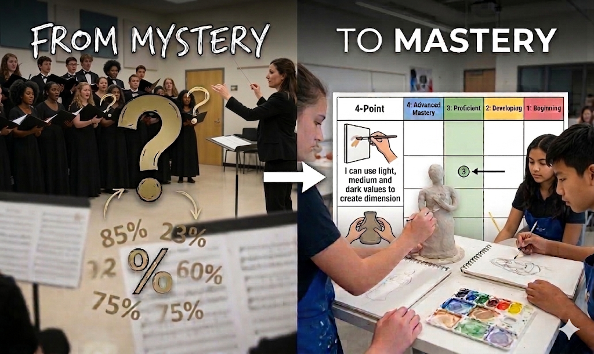
Think back to your own arts education. Whether it was choir, drama or visual art, how was your grade determined? For many of us, it was a mysterious blend of “participation,” showing up to the concert or a teacher’s general perception of our talent. We often viewed grading as a bureaucratic afterthought—something to “fill a grade” once the performance was over or the project was turned in.
But how do we effectively evaluate artistry, growth and skill in a performance-based classroom? Traditional methods often collapse individual accountability into the success of the ensemble or the craftsmanship of a final product. Standards-Based Grading (SBG) offers a clear path forward, shifting the focus from vague percentages to a roadmap for individual student improvement.
What is Standards-Based Grading?
SBG measures how well students master specific standards separate from effort or behavior. Instead of one overall grade, students receive descriptive scores (typically a 1–4 scale) for specific goals. This ensures grades reflect a student’s journey from their own “Point A” to “Point B”.
4 Ways to Make the Shift in Your Arts Classroom
1. Translate Broad Standards into “I Can” Statements
Break down dense standards into measurable goals so students have a clear roadmap:
- Visual Art: “I can use light, medium and dark values to create dimension in charcoal drawings.”
- Music: “I can sight-read an 8-measure melody with accurate rhythm and pitch.”
- Drama: “I can use vocal projection to be understood from any point in the theater.”
- Dance: “I can maintain the demonstrated body alignment and posture during floor exercises.”
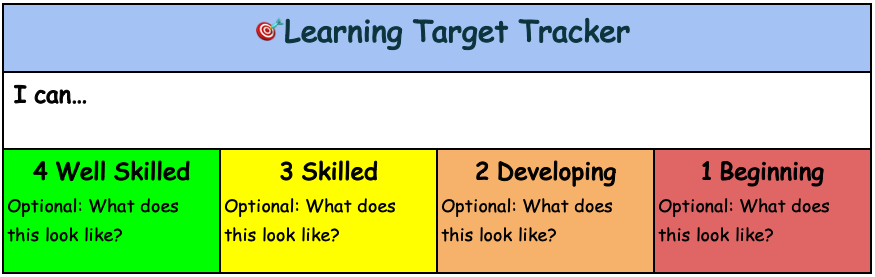
For a comprehensive look at how these targets translate into final letter grades and to see specific case studies here.
2. Redefine Participation as Observable Skills
Instead of a participation score that rewards sitting quietly, define essential rehearsal and studio behaviors as measurable skills:
- Ensemble Work (Music/Drama): “I can respond immediately to the conductor’s cues or director’s notes.”
- Studio Maintenance (Visual Art): “I can maintain a responsible workspace and care for materials.”
- Physical Preparation (Dance): “I can effectively warm up using proper alignment and self-correction.”
3. Use the “Take 1 / Take 2” Model
Learning is an iterative cycle. In this model, the first attempt (Take 1) is for data collection. If a student hasn’t reached proficiency, they receive targeted feedback and re-teaching before a guaranteed Take 2 reassessment. This builds accountability and reinforces that improvement is expected.
4. Focus on the Individual, Even in the Ensemble
In large groups, it is easy to default to group grades. SBG encourages tracking individual growth. Educators may consider using seating charts to mark individual scores during rehearsals or using short video recordings for accurate scoring and student self-reflection.
The Results: Mastery and Joy
The impact of this shift is measurable. When I adopted a four-point system for a notoriously difficult AP Music Theory course, 100% of my students passed the College Board exam, with averages exceeding state and global benchmarks.
By focusing on growth and clear standards, we preserve the joy of the arts while equipping students with the self-discipline needed to thrive. SBG ensures that grading becomes a powerful force that enhances the artistry of our teaching.
This post is an excerpt from a larger work on reimagining arts assessment. For the full technical breakdown, including detailed grading conversion tables and additional classroom examples, read the entire article, Standards-Based Grading in the Arts.